
GET an arsenal of free tools for Traffic
https://leadsleap.com/?r=millionaire200
Get a free website, Complete Money-Making Site Setup FREE!
Create Your Free Account
https://www.pluginprofitsite.com/main-50390/join.html
https://www.pluginprofitsite.com/main-50390/freesetup.html
MONEY MAKERS
https://blog.moneymakerswebcast.com/
Effortless Money Don't miss it
https://MoneyMakersWebcast.com/?cp=qi5A4J0Q
Save Your Marriage: A Step-by-Step Guide to Reconnecting and Rebuilding Trust
https://blog.moneymakerswebcast.com/view_article.cfm?id=1973
Lose Belly Fat in 2 Weeks: A Realistic Action Plan for a Flatter Stomach
https://blog.moneymakerswebcast.com/view_article.cfm?id=1945
30-Day Challenge to Your First $1,000
https://MyViralFunnel.com/628970
Limited Time Offer: Free Traffic Power Pack,
https://www.moneymakerswebcast.com/?cp=uf9fXtlV
BUCKET
https://moneymakerswebcast.com/?cp=pd7YjARZ
The Great Schism & Beyond
Understanding the Deep Roots of Catholic and Orthodox Christianity
For nearly a millennium, the Christian world was largely united. However, in 1054 AD, a "Great Schism" fractured the Church into what we now know as the Roman Catholic Church and the Eastern Orthodox Church. While they share a common foundation in the life and teachings of Jesus Christ, their paths have diverged through culture, politics, and theology.
🏛️ Two Empires, One Faith
The divide was not an overnight event but a slow cooling of relations. As the Roman Empire split into Western (Latin-speaking) and Eastern (Greek-speaking) halves, the churches followed suit. The West centered on Rome, while the East centered on Constantinople (modern-day Istanbul).
The Roman West
Influenced by Roman law and Latin logic. Focused on hierarchy, legal definitions of sin, and the central authority of the papacy.
The Byzantine East
Influenced by Greek philosophy and mysticism. Focused on the "mystery" of the divine, liturgy, and a collegial leadership of bishops.
“
The Church breathes with two lungs—the East and the West—and it must breathe with both to be whole.
— Pope John Paul II
👑 The Question of Authority
The single biggest point of contention between the two traditions is the Papacy.
Catholic View: The Pope (Bishop of Rome) is the "Vicar of Christ" and has immediate, supreme jurisdiction over the entire universal Church. He is seen as the successor of St. Peter.
Orthodox View: The Bishop of Rome is historically the "first among equals" (primus inter pares). However, the Orthodox do not believe he has authority over other bishops. They are organized as autocephalous (self-governing) national churches.
📜 Theological Nuances
While sharing 90% of their theology, the 10% difference has led to centuries of debate. Two major points stand out:
⚡ The Filioque Controversy
In the Nicene Creed, Catholics added the Latin phrase "filioque" (and the Son) to describe the Holy Spirit's origin. The Orthodox reject this addition, arguing it was not agreed upon by an ecumenical council and changes the fundamental nature of the Trinity.
Original Sin
Catholics traditionally emphasize the guilt inherited from Adam. Orthodox emphasize the mortality (death) inherited from Adam, preferring the term "Ancestral Sin."
Purgatory
The Catholic Church teaches the existence of Purgatory—a place of cleansing before entering Heaven. The Orthodox pray for the dead but generally lack a formal "logistics" of Purgatory.
🎨 Rites and Rituals
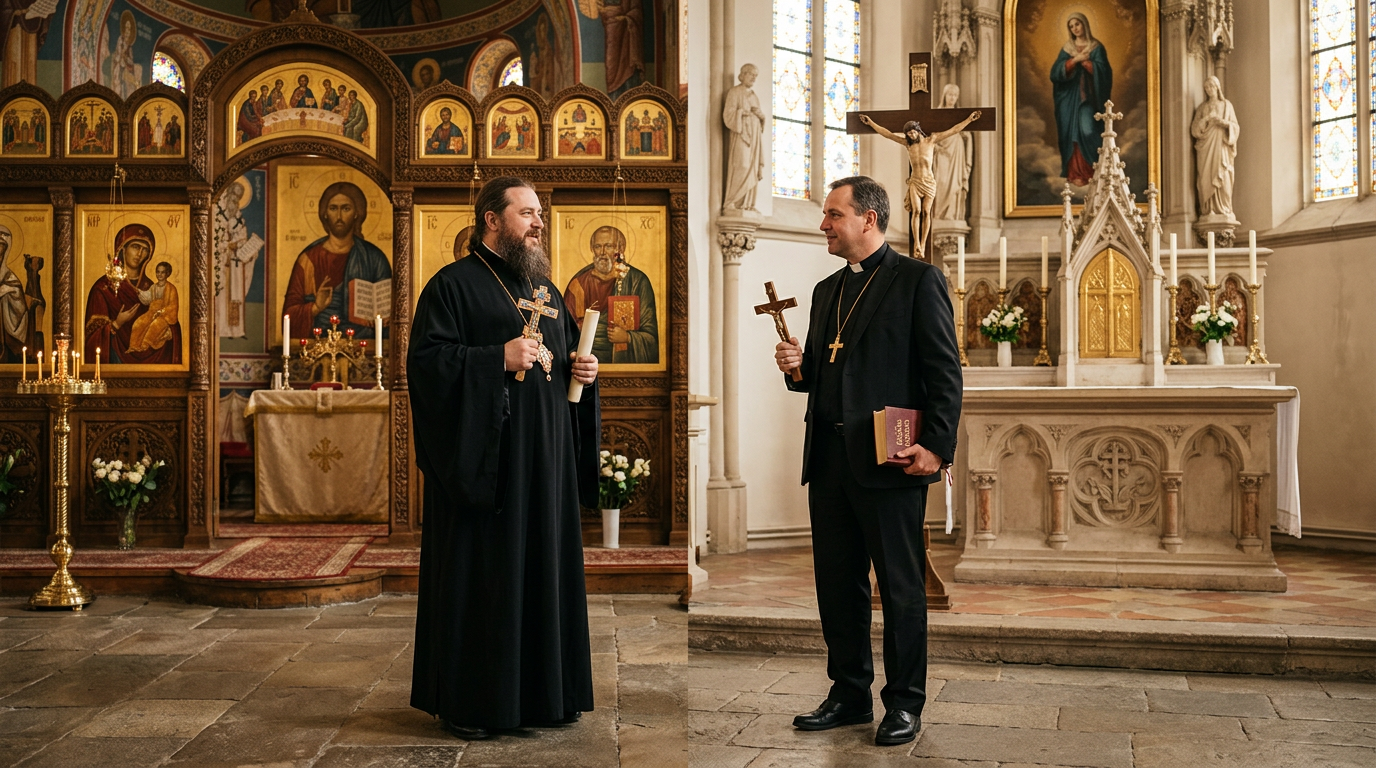
If you walked into a Catholic Mass and an Orthodox Divine Liturgy, you would feel a distinct difference in atmosphere.
✓
Icons vs. Statues: Orthodox churches are filled with icons (2D sacred windows to heaven) and forbid statues. Catholic churches frequently use both icons and 3D statuary.
✓
The Eucharist: Catholics use unleavened bread (wafers). Orthodox use leavened bread, symbolizing the "rising" of the Risen Christ.
✓
Clerical Celibacy: In the Latin Rite Catholic Church, priests must be celibate. In the Orthodox Church, men can be married before they are ordained as priests (though bishops must be celibate).
At a Glance
1.3B+
Catholics Worldwide
260M+
Orthodox Worldwide
1054
Year of the Schism
🛡️ Common Grounds
Despite the differences, it is crucial to recognize that both churches consider themselves the "One, Holy, Catholic, and Apostolic Church." They both share:
Apostolic Succession: Both believe their bishops can trace an unbroken line back to the Apostles.
The Real Presence: Both believe that bread and wine literally become the Body and Blood of Christ.
Veneration of Mary: Mary is honored as the Theotokos (God-bearer) in both traditions.
The Seven Sacraments: Baptism, Confirmation/Chrismation, Eucharist, Penance, Anointing of the Sick, Holy Orders, and Matrimony.
🎯 Summary: A Tale of Two Expressions
The difference between Orthodox and Catholic is rarely a matter of "right vs. wrong" in their own eyes, but rather a difference in emphasis and governance. Catholicism emphasizes unity through the Papal Office and a systematic approach to theology. Orthodoxy emphasizes unity through the Liturgy and a mystical approach to faith. While the theological divide remains, modern dialogues between the Pope and the Patriarch of Constantinople suggest a growing desire for reconciliation and an eventual "healing of the breach."
© 2023 Theological Insights Journal • Exploring the Depths of History